Service · Buyback
Sell us your pallets and get your dock back
We buy cores in any condition short of contaminated. You get paid per unit, the trailer comes to you, and the stack behind your building stops being a fire-marshal conversation.
Request pricing
Everything marked with a star is required. The rest helps us quote faster.
RePallet Co. buys used pallets across the Denver metro and the Front Range, pays per core, and collects at our own cost on volumes above roughly 400 units. Sound 48" x 40" GMA cores typically fetch $3.50–$8.50 each; Euro pallets more; odd and damaged sizes less.
Send a footprint, a rough count and your postcode and you will have a per-unit offer and a collection window within one business day. We buy broken pallets too — they become lumber, not landfill.
What your pallets are worth
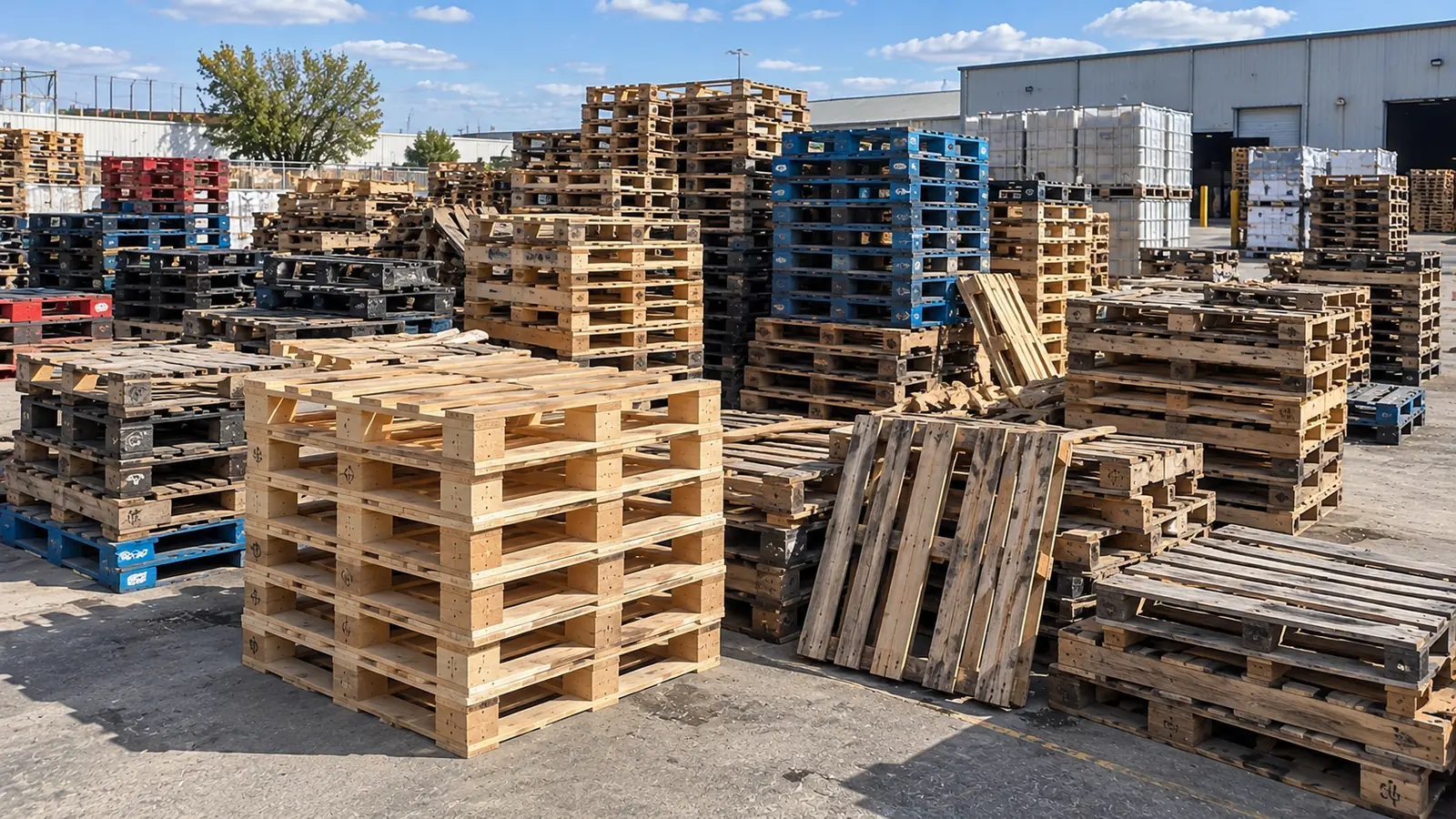
Four things set the price: the footprint, the condition, how many you have, and how far the trailer drives. Nothing else matters much. The table below is what we actually pay in the Denver metro — it moves with lumber prices, so treat it as a working range rather than a price list.
| What you have | Condition | Typical per unit | Notes |
|---|---|---|---|
| 48" x 40" GMA | Sound, both decks intact | $5.00 – $8.50 | Our highest-demand core |
| 48" x 40" GMA | Repairable, broken board or stringer | $2.25 – $4.50 | Straight onto the repair line |
| 48" x 40" GMA | Beyond repair | $0.75 – $1.75 | Dismantled for lumber and mulch |
| Euro / EPAL | Stamped, sound | $9.00 – $16.00 | Verify the EPAL oval first |
| Block pallets (non-pooled) | Sound | $6.00 – $11.00 | Must not be pool property |
| Odd sizes (36", 42", 44", 45") | Sound | $2.00 – $6.00 | Depends on whether we have a buyer |
| Mixed unsorted stacks | Assorted | $1.50 – $4.00 | Sorting cost comes off the price |
| Plastic pallets | Uncracked | $4.00 – $22.00 | Wide range; resin and style dependent |
How the buyback works
- 1
Send the details
Footprint, rough count, postcode, dock hours. A phone photo of a stack lets us grade before we roll.
- 2
Get an offer
Per-unit price, whether collection is free, and a window — usually within one business day.
- 3
Confirm in writing
You accept by email. We issue a purchase confirmation with the agreed rate.
- 4
We collect
Flatbed, curtain-side, or a drop trailer we leave with you to fill at your own pace.
- 5
Count and pay
Counted on the yard scale and deck, photographed, then paid by ACH — typically within five business days.
For sites that generate pallets continuously — grocery DCs, 3PLs, breweries — a standing route is far better than ad-hoc calls. We agree a cadence, leave a trailer, and swap it when it is full. You never think about it again.
Getting the best price for a stack
Nothing here is compulsory, and we will still buy your pallets if you do none of it. But each of these things removes labour from our end, and we pass most of that back.
- Sort by footprint. Even rough separation between 48x40 and everything else can add a dollar a unit.
- Stack them square. Leaning stacks slow loading and increase damage in transit.
- Keep them dry. Wet wood is heavy, stains, and can grow mould that makes a load unsellable. A tarp is cheap.
- Pull the obvious write-offs. Not to discard — we buy those too — just so the count is honest.
- Tell us about contamination. Chemical spills, food residue, fire or flood damage change what we can legally take.
- Give realistic dock hours. A driver who arrives at the wrong time costs both of us a slot.
There is a printable version of this on our pallet buyback checklist, and a longer explanation in how to sell used pallets.
Why sell rather than skip
Most companies do not compare the two options properly, because the skip is a facilities cost and the pallets are an operations problem. Put them side by side and the difference is stark. A 30-yard roll-off holding roughly 150 pallets costs $450–$700 to haul in Denver and delivers you nothing. The same 150 sound 48x40 cores are worth $750–$1,275 to you, and 2.4 tonnes that never reach a landfill.
The arithmetic on 150 pallets
One skip versus one buyback, using mid-range Denver numbers. The swing is over $1,500 on a single load — before you count the landfill tipping fee or the space the stack was occupying.
- Roll-off skip: −$575 average haul cost
- RePallet buyback: +$975 at $6.50 per core
- Net swing: $1,550
- Landfill diverted: 2.4 tonnes
- CO₂e avoided: 720 kg
Run your own numbers on the ReLoop Ledger.
What we look for, unit by unit
A buyback offer is really a prediction about how a load will grade when it reaches the sort line. Here is what the grader is actually deciding, so you can predict it too.
| What the grader sees | Routed to | Effect on value |
|---|---|---|
| Sound, both decks complete, original stringers | Reuse after inspection | Top of the range |
| One or two broken deck boards | Repair line | Mid range; still a good core |
| Cracked stringer at the notch | Repair with a plug | Lower; the fix takes 2 – 3 minutes |
| Stringer split on the nail line | Companion stringer | Lower still |
| Broken stringer, both sides | Dismantle for lumber | Lumber value only |
| Shiners across the deck | Shear and reset | No downgrade |
| Heavy staining, no structural damage | Wash and re-grade | Small deduction |
| Mould bloom | Rejected | No value; disposal at our cost |
| Chemical staining we cannot identify | Rejected | No value |
| Pooled pallet (painted blocks) | Sorted and returned to the pool | Not purchased |
How the offer is built
We estimate the mix — what share of the load will land in each row above — from your description and photographs, then apply the rate for each. That is why a photograph is worth so much more than a paragraph: it moves the estimate from a guess to an observation.
If the actual mix differs materially from the estimate, we contact you before processing rather than after. That has happened perhaps a dozen times in three years, and in most of them the load graded better than expected.
Standing programmes for continuous generators
If your site produces pallets every week, ad-hoc collection is the wrong model. It creates a recurring scheduling conversation, it lets accumulation build to the point where it becomes a fire-code question, and it prices worse.
- 1
Agree a cadence
Weekly, fortnightly or monthly, at a fixed slot your dock team can plan around.
- 2
Agree a rate card
Per footprint and per grade, fixed for the term with a lumber-index review.
- 3
Choose the equipment
Scheduled trailer, or a drop trailer that lives on your site and gets swapped when full.
- 4
Single monthly reconciliation
One statement netting buyback against any supply. No per-load invoicing to chase.
- 5
Quarterly review
We share your failure mix — what is actually breaking your pallets — so you can fix it upstream.
Paperwork, tax and audit
Selling used pallets is a straightforward sale of goods, but several customers have needed to explain it to a finance team or an auditor. This is what we provide without being asked.
- A purchase confirmation stating the agreed rate per grade before collection.
- A counted and photographed deck count at the yard, or a signed ticket at loading if you prefer.
- A self-billed invoice or your own invoice, whichever your process needs.
- ACH remittance with the batch reference on it, typically within five business days.
- A Pallet Passport batch record with weights, disposition split and avoided CO₂e for your own reporting.
- A W-9 and certificate of insurance on request, usually returned the same day.
On revenue recognition
For most customers pallet buyback appears as miscellaneous income or as a credit against waste disposal, and either is defensible. If your accounting treats packaging as an asset rather than a consumable, tell us and we will structure the documentation to match — it costs us nothing and saves you an argument.
Questions people actually ask
How many pallets do I need before you will collect?
Do you buy broken pallets?
How quickly do I get paid?
Can you take pallets that have been outside all winter?
What about pallets with our company name stencilled on them?
Will you buy a single stack?
What if the load grades worse than you estimated?
Do you buy plastic pallets?
Can you take pallets with product still on them?
We are a landlord clearing a vacated unit — can you help?
Let's keep your pallets in the loop
Whether you have 40 broken cores behind the dock or need 4,000 Grade A pallets a month, the conversation starts the same way.