Size · Europe
The Euro pallet, and how to tell a real one
1200 x 800 mm, eleven boards, nine blocks and seventy-eight nails driven to a defined pattern. The most tightly specified pallet in the world — and the most counterfeited.
Request pricing
Everything marked with a star is required. The rest helps us quote faster.
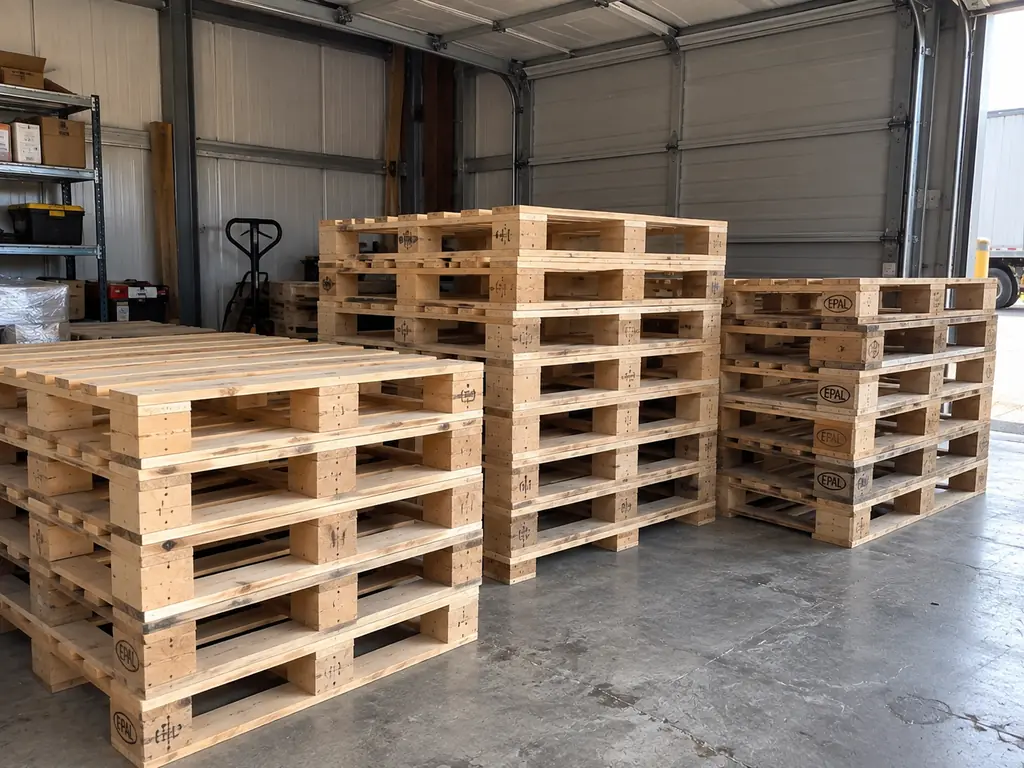
The Euro pallet (EPAL / EUR 1) measures 1200 x 800 mm (47.24" x 31.5"), weighs about 25 kg, and carries a safe working load of 1,500 kg dynamic and up to 4,000 kg static. It is a block pallet with full four-way entry.
A genuine exchangeable Euro pallet carries the EPAL oval branded into the corner blocks, plus a control nail. Without those marks it is a 1200 x 800 pallet, not a Euro pallet, and it cannot be exchanged.
Specification
| Attribute | Value |
|---|---|
| Footprint | 1200 x 800 mm (47.24" x 31.5") |
| Height | 144 mm |
| Weight | 22 – 25 kg (49 – 55 lb) |
| Construction | Block pallet, 9 blocks |
| Top deck | 5 boards (3 × 145 mm, 2 × 100 mm) |
| Bottom deck | 3 boards plus 2 edge runners |
| Fasteners | 78 nails, specified pattern and length |
| Fork entry | Full 4-way |
| Safe working load | 1,500 kg dynamic |
| Maximum static load | 4,000 kg |
| Racking load | 1,000 kg unsupported span |
| Marking | EPAL oval on both outer block faces, control nail |
Verifying a Euro pallet
Counterfeit Euro pallets are common enough that checking is worth the thirty seconds. Four marks, all on the corner blocks.
- EPAL oval branded (not printed) into the left corner block, on both sides.
- Country and licence code on the right corner block — country code, licence number and production year.
- IPPC / ISPM 15 mark on the centre block: the wheat symbol, country code, registration and HT.
- The control nail driven into the centre block on the diagonal, stamped on its head. This is the hardest mark to fake and the one a professional buyer checks first.
Euro pallets in North America
Euro pallets arrive in Denver on imported freight and then create a small problem: they do not fit North American racking, they do not palletise efficiently in a 96" trailer, and there is no exchange pool to return them to. Most end up stacked behind a warehouse.
- Two Euro pallets are 1600 mm across — roughly 63", wasting 33" of a 96" trailer width.
- Racking designed for 48" depth leaves a 1200 mm (47.2") Euro pallet slightly under-supported at the beams.
- There is no exchange in the US. The European exchange system does not operate here.
- They are worth good money as cores — we pay $9 to $16 for sound, stamped units.
- They are excellent pallets. If you run an internal loop, a Euro pallet will outlast two GMA pallets.
If Euro pallets are accumulating on your site, that is a buyback conversation, not a waste conversation. See sell us your pallets.
The wider EPAL family
EUR 1 — the 1200 x 800 mm pallet everybody means by “Euro pallet” — is one of several standardised EPAL footprints. The others turn up on imports and in specialist supply chains.
| Designation | Size (mm) | Size (in) | Typical use |
|---|---|---|---|
| EUR / EUR 1 | 1200 x 800 | 47.24" x 31.50" | The European standard |
| EUR 2 | 1200 x 1000 | 47.24" x 39.37" | Industrial, chemical, machinery |
| EUR 3 | 1000 x 1200 | 39.37" x 47.24" | Rotated EUR 2; some beverage |
| EUR 6 (half) | 800 x 600 | 31.50" x 23.62" | Retail display and merchandising |
| Quarter | 600 x 400 | 23.62" x 15.75" | Promotional display |
| EPAL CP series | Various | Various | Chemical industry, one-way |
CP pallets are not exchangeable
The CP series — CP1 to CP9 — are chemical-industry pallets built to agreed specifications but not part of the exchange pool. They arrive on chemical imports and are frequently mistaken for exchangeable Euro pallets. They are good pallets and they are worth buying; they are not worth Euro-pallet money.
Why Euro pallets outlast GMA pallets
A genuine EPAL pallet will comfortably outlast two GMA pallets in the same loop. The reasons are specific and worth understanding even if you never buy one.
- Block construction. Nine solid blocks distribute load far better than three notched stringers, and there is no notch to blow out — the single most common structural failure on a GMA pallet.
- Seventy-eight nails to a defined pattern. Fastening is specified rather than left to the builder, and the pattern is designed for the loads the pallet actually sees.
- Specified timber. Board thicknesses and block dimensions are fixed by UIC 435-2 rather than by whatever a mill had.
- Moisture specification. Genuine EPAL production controls moisture content, which reduces the splitting that shortens a pallet's life.
- Licensed repair. Repairs are performed by licensed shops to a standard, and a repaired pallet carries a repair nail so its history is visible.
| GMA 48x40 hardwood | EPAL Euro pallet | |
|---|---|---|
| Typical lives with repair | 6 – 8 | 10 – 15 |
| Weight | 33 – 40 lb | 49 – 55 lb |
| Unit cost, used | $8.50 – $13.50 | $16.00 – $26.00 |
| Cost per trip (used, 5 trips vs 12) | ≈ $2.75 | ≈ $1.90 |
| Dominant failure | Notch blow-out | Block or bottom-board damage |
| Repairability | Excellent and cheap | Good but slower |
If Euro pallets are piling up at your site
This is the most common Euro-pallet conversation we have, and the answer is almost never what the customer expected.
- 1
Do not skip them
They are the most valuable core in our yard. A skip converts $9 to $16 a unit into a disposal cost.
- 2
Photograph the corner blocks
Verification takes us ten seconds and changes the offer substantially.
- 3
Separate CP pallets
Good pallets, different price. Mixing them in depresses the blended rate.
- 4
Ask whether you should keep them
If you run an internal loop, a Euro pallet will outlast two GMA pallets. Sometimes the right answer is to use them.
- 5
Sell the rest
We buy, and the dismantled lumber is unusually good — consistent European softwood, kiln dried, heat treated.
One genuinely useful trick: if you import on Euro pallets regularly and also export, ask your forwarder whether you can send goods out on them. Sending a Euro pallet back toward Europe solves a problem at both ends and costs nothing extra.
Questions people actually ask
Can I exchange Euro pallets in the United States?
Why do Euro pallets cost so much more?
What is EUR 2, EUR 3 and EUR 6?
Do you stock Euro pallets?
How can I tell a repaired EPAL pallet?
What is the difference between EPAL and EUR marks?
Do Euro pallets fit US racking?
Why do Euro pallets weigh so much?
Can I get Euro pallets built new in the US?
Let's keep your pallets in the loop
Whether you have 40 broken cores behind the dock or need 4,000 Grade A pallets a month, the conversation starts the same way.