Service · Recycling
Pallet recycling with nothing left over
Recycling is the third thing we try, not the first. Repair beats recycling by an order of magnitude — but when a pallet is genuinely finished, every part of it still has a buyer.
Request pricing
Everything marked with a star is required. The rest helps us quote faster.
RePallet Co. runs a zero-landfill pallet recycling operation in Denver: cores are graded, repaired where possible, and otherwise dismantled into reclaimed lumber, magnet-separated scrap steel and ground wood fibre. Nothing from 4890 Geneva St goes to a landfill, and the tonnage is audited annually.
For generators, recycling is usually free or revenue-positive: we pay for sound cores and typically collect mixed loads at no charge above 400 units inside the metro.
The waste hierarchy, applied to a pallet
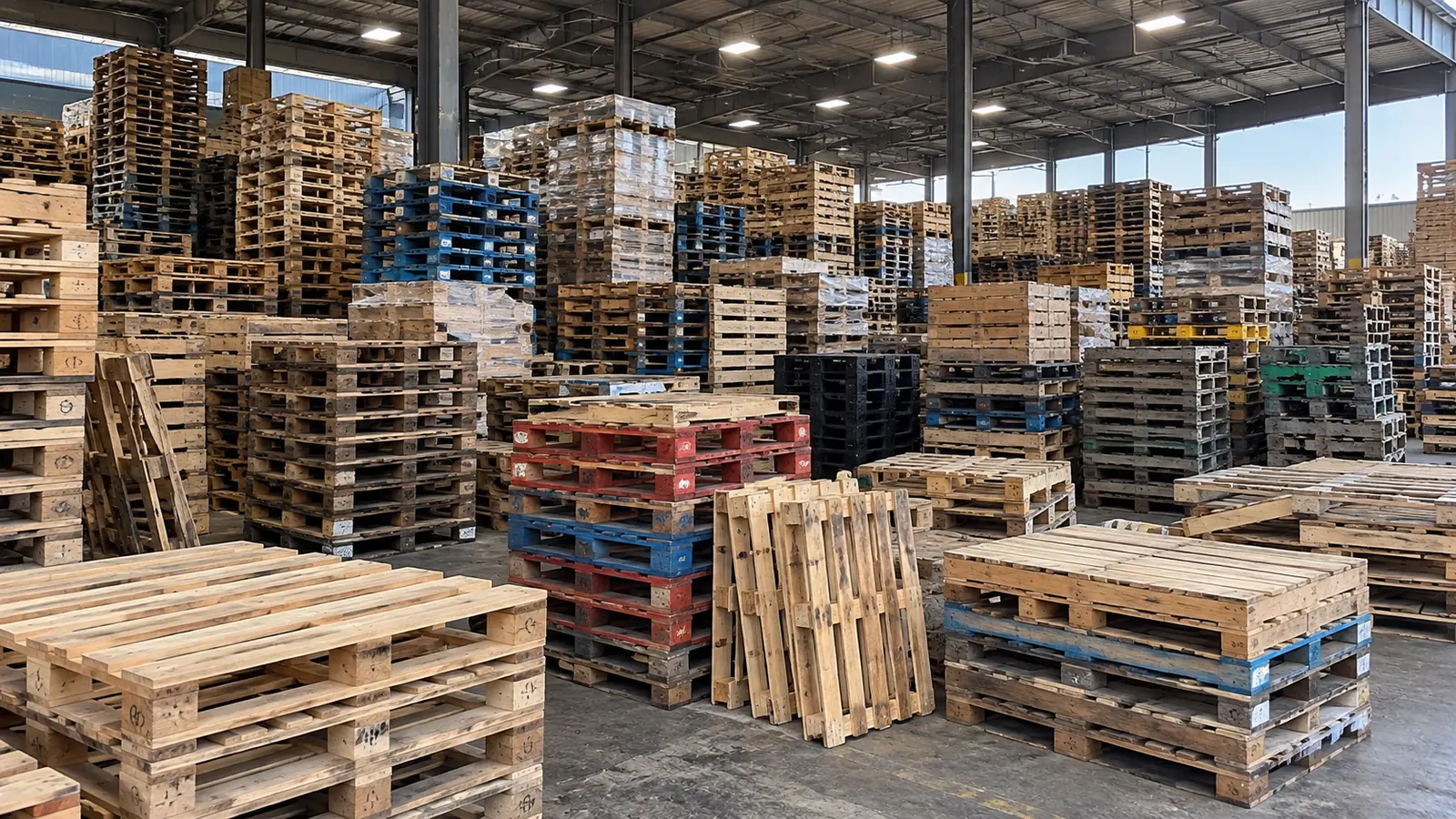
"Recycling" is used loosely in this industry, and the looseness hides a big difference in impact. Grinding a repairable pallet into mulch destroys 23 board feet of usable lumber to produce a product worth a few dollars a cubic yard. Repairing it preserves the embodied energy of the whole unit. We work strictly down the hierarchy, and the order matters more than any single step.
- 1
Reuse as-is
Roughly 46% of incoming cores need nothing but inspection and a clean. They go straight back out.
- 2
Repair
About 31% need one to four boards or a companion stringer. Back to Grade A or B.
- 3
Remanufacture
Around 12% are cut down and rebuilt into smaller footprints — half pallets, skids, display bases.
- 4
Recover lumber
Roughly 8% yield usable boards and runners for cladding, furniture and crating.
- 5
Recycle fibre and steel
The final 3% becomes mulch and animal bedding; nails and banding go to a scrap smelter.
Those percentages are last year's yard average across 186,000 incoming cores. They move with the season — winter intake is wetter and repairs more — but the shape holds.
Inside the dismantling line
A pallet that fails inspection goes to the band-saw dismantler, which separates deck boards from stringers with the nails still in them. From there it is four stations, and the wood gets less valuable at each one — which is exactly why we sort hard at the front.
Board recovery
Deck boards over 30" with sound grain are de-nailed and stacked for reuse on the repair line or sold as reclaimed cladding. This is where most of the recovered value sits.
Runner recovery
Stringers that split along the nail line are trimmed and sold as landscape edging, crate runners or firewood-length stock.
Steel separation
An overhead magnet pulls nails, staples and strapping from the chip stream. We ship about 14 tonnes of ferrous scrap a year to a Colorado smelter.
Fibre grinding
What remains is hammer-milled and screened into landscape mulch, playground fibre and animal bedding — dyed on request. See colored mulch.
Reporting you can put in an ESG document
Most recyclers give you a weight ticket. That is not reporting — it is a receipt. Every batch through our yard gets an RPC reference that records intake weight, the reuse/repair/recycle split, recovered board feet, steel tonnage, fibre tonnage and the CO₂e avoided against a new-pallet baseline.
- Intake weight and unit count, by footprint
- Reuse, repair, remanufacture and recovery percentages
- Board feet of lumber returned to circulation
- Ferrous scrap tonnage and receiving smelter
- Fibre tonnage and end use
- CO₂e avoided, with the factor and source stated
You can look up any batch yourself on the Pallet Passport page, and the factors behind the carbon line are documented on our methodology page. We publish the assumptions we think are weakest as well as the ones we are confident about.
What zero landfill actually costs
Honesty: zero landfill is not free, and any recycler who tells you otherwise is either subsidising it from somewhere else or quietly sending fines to a tip. Our fibre line runs close to break-even. The steel pays for itself. The repair line pays for everything.
That is the actual business model, and it is why we grade so aggressively at intake. Every pallet we can repair instead of grind is roughly nine dollars of margin — and 4.8 kilograms of CO₂e that does not get emitted. The incentives point the same direction as the ethics, which is a rare and pleasant thing.
What we can and cannot accept
Being specific about this saves wasted trips and awkward conversations on a dock. The list is shorter than people expect in one direction and longer in the other.
| Material | Accepted? | Notes |
|---|---|---|
| Wooden pallets, any grade | Yes | Including units beyond repair |
| Broken cores, loose boards, stringers | Yes | Straight to the dismantling line |
| Wooden crates and boxes | Yes | Nails and banding removed on the line |
| Bulk bins, wood | Yes | Repaired or dismantled |
| Dunnage and bracing timber | Yes | If free of fasteners we cannot detect |
| Plastic pallets | Yes | Purchased, not recycled — they go to a resin route |
| Pooled pallets | No | Sorted out and returned to the operator, free |
| MB-stamped wood | No | Excluded from every recovery stream |
| CCA-treated, creosoted or painted timber | No | Licensed disposal route required |
| Plywood, OSB, particleboard | No | Adhesives do not belong in fibre |
| Chemically contaminated wood | No | Tell us and we will point you at a licensed route |
| Fire-damaged wood with melted plastic | No | Contamination is not separable |
| Live infestation or quarantine material | No | Regulatory route only |
Reporting for ESG, CSRD and customer audits
The reporting requirements landing on Front Range businesses have got sharper in the last three years, mostly driven by customers rather than by regulators. Most recyclers are not set up for it. Here is what we issue and what each field is for.
| Field | Source | Typically used for |
|---|---|---|
| Intake weight | Our weighbridge | Waste diversion tonnage |
| Unit count by footprint | Sort line count | Circularity rate by product |
| Reuse / repair / remanufacture / recovery split | Sort line routing | Waste hierarchy reporting |
| Landfill tonnage | Rejection log | Zero-landfill verification |
| Board feet recovered | De-nailing line | Material circularity indicator |
| Ferrous scrap tonnage | Magnet separation | Metals recovery |
| Fibre tonnage and end use | Screening line | Recovery reporting |
| CO₂e avoided | Published factor × count | Scope 3 category 5 and 12 |
| Factor and source | Methodology page | Auditor verification |
What we will not put on a certificate
- Sequestered carbon. Contested accounting; including it would roughly sextuple our headline figure.
- Avoided landfill methane where the material would have gone to another recycler anyway.
- Gross rather than net figures. Our own freight emissions are subtracted before we report.
- A recovery percentage we cannot evidence from the sort line count.
The full method, including the assumptions we consider weakest, is on the carbon methodology page. If your auditor wants to speak to somebody, ask and we will arrange it.
Setting up a site programme
- 1
Baseline week
Count what accumulates in seven typical days. That is all the data required to design the rest.
- 2
Segregation plan
Where pallets go, who moves them, and how pooled units get separated at source.
- 3
Equipment
Scheduled collection, a drop trailer, or a compactor-free bay depending on your footprint.
- 4
Signage and training
We provide laminated sort guides. Ten minutes with a dock team removes most contamination.
- 5
First quarter review
Actual volumes against the baseline, failure mix, and whether the cadence is right.
Programmes of this kind take about three weeks from first email to first scheduled collection, and the largest single determinant of whether they work is whether one named person at your end owns it. Not their seniority — just that the role exists.
Questions people actually ask
Does pallet recycling cost me anything?
Can you handle a full warehouse decommission?
What happens to the nails?
Do you provide a certificate of recycling?
Is mulch really recycling?
Do you provide containers or bays?
Can you handle a site with mixed waste streams?
How do I prove zero landfill to a customer?
What happens to plastic pallets you take?
Is there a contract?
Let's keep your pallets in the loop
Whether you have 40 broken cores behind the dock or need 4,000 Grade A pallets a month, the conversation starts the same way.