Service · Buying
Buy used pallets that were actually inspected
Grade A and Grade B stock in fifteen footprints, pulled from a four-acre yard in north-east Denver. Every pallet is hand-graded against a written standard before it goes on your trailer.
Request pricing
Everything marked with a star is required. The rest helps us quote faster.
RePallet Co. sells graded used wooden pallets from 4890 Geneva St in Denver, in quantities from 25 units to full 53' truckloads. The core stock is 48" x 40" GMA in Grade A (#1) and Grade B (#2), alongside Euro/EPAL, block pallets, 36" and 48" squares, half pallets and odd sizes.
Typical Denver-metro pricing runs roughly $8.50–$13.50 for Grade A 48x40 and $5.50–$9.00 for Grade B, before freight. Orders confirmed before 11 AM Mountain Time can usually be pulled and banded the same day for next-day collection.
What we hold, and what it costs
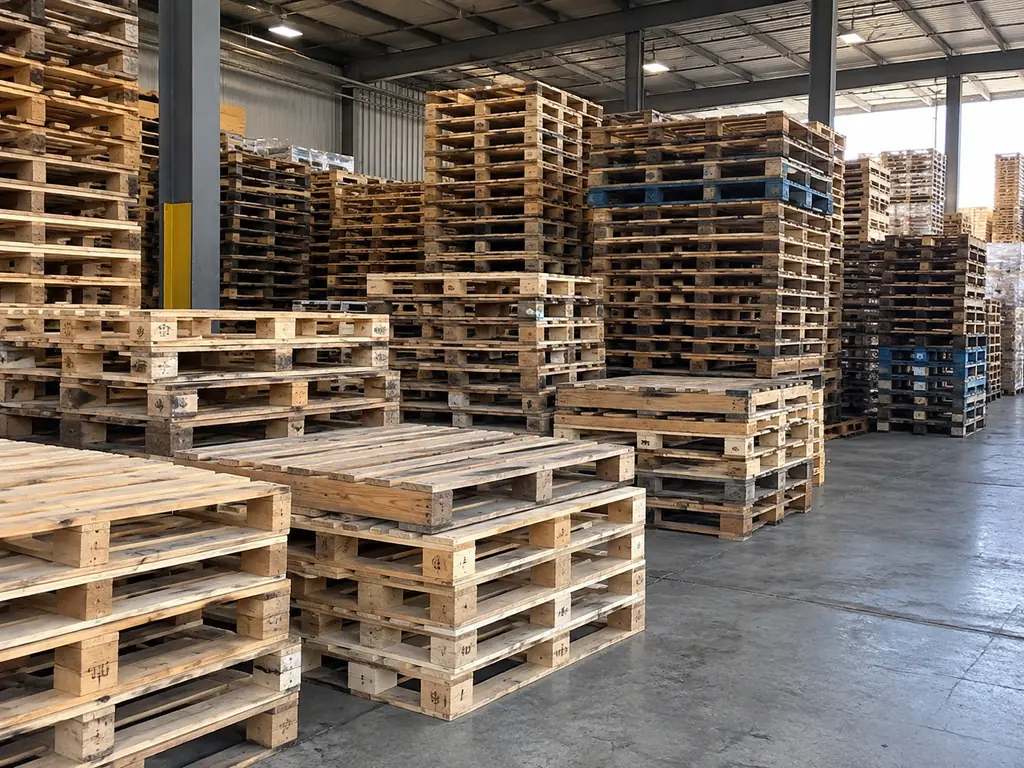
A recycled pallet is not a commodity in the way a pallet broker's price list implies. Two loads of "48x40 Grade A" can differ by four dollars a unit depending on species, how many boards were replaced, whether the stringers are original and how recently the wood was outdoors. We publish ranges rather than fixed prices because the yard's inventory turns over weekly — but the ranges below are honest, and the quote you receive will sit inside them.
| Footprint | Grade | Typical price | Usual availability |
|---|---|---|---|
| 48" x 40" GMA stringer | Grade A (#1) | $8.50 – $13.50 | In stock most weeks, 500+ units |
| 48" x 40" GMA stringer | Grade B (#2) | $5.50 – $9.00 | In stock, high volume |
| 48" x 40" GMA stringer | Grade C / core | $2.75 – $5.00 | Sold for repair or dismantling |
| Euro pallet (EPAL 1200x800) | Grade A / B | $16.00 – $26.00 | Limited, ask before you plan |
| 48" x 40" block (non-pooled) | Grade A | $14.00 – $22.00 | Intermittent |
| 36" x 36" keg square | Grade A | $9.00 – $14.00 | Seasonal, strongest in spring |
| 48" x 48" drum square | Grade A | $11.00 – $17.00 | Regular |
| Half pallet 48x20 (built new) | New from reclaimed | $12.50 – $18.00 | Built to order, 5–10 days |
How our grades are defined
Every yard in the country uses the words "A" and "B", and almost none of them mean the same thing. Ours are written down, photographed and attached to your order acknowledgement so there is nothing to argue about on the dock.
Grade A (#1)
All original stringers, no plugs or companion stringers. Both decks complete. No more than two replaced deck boards. Clean, dry, no staining, no protruding fasteners. Suitable for automated handling and rack storage.
Grade B (#2)
Structurally sound with repairs visible: plugged or companion stringers permitted, up to four replaced deck boards, minor staining acceptable. Fine for floor stacking and general shipping, not for high-speed conveyors.
Grade C / core
Serviceable lumber, not a serviceable pallet. Broken stringers, missing lead boards or heavy wear. Sold to repair shops and to customers who only need a one-way dunnage pallet.
If a delivered load misses the grade you were quoted, tell us within two business days. We swap it or credit it — we do not negotiate about it. That policy exists because the alternative, arguing over photographs, costs everyone more than the pallets are worth. Read the full standard in pallet grades explained.
Buying by the truckload
A standard 53' dry van holds roughly 560 to 620 48x40 pallets stacked in columns of 14 to 15, depending on deck thickness and whether you want them banded. A flatbed carries fewer but loads and unloads faster with a forklift on either end. For most Front Range customers the economics tip toward truckload buying somewhere around the 400-unit mark.
- 1
Confirm the spec
Footprint, grade, banding, wrapping, and whether mixed species is acceptable.
- 2
Reserve the stock
We tag the lot in the yard so it is not sold out from under your order.
- 3
Book the trailer
Ours or yours. We load flatbeds, dry vans, curtain-sides and drop trailers.
- 4
Load and photograph
Every truckload is photographed before the doors close. The photos go with the paperwork.
- 5
Passport the batch
You receive an RPC batch reference you can quote in your own reporting.
For recurring volume we will hold stock against a rolling forecast rather than making you order load by load. That is what a pallet management programme is for.
Why buy recycled rather than new
The financial case is obvious — a Grade A recycled 48x40 lands at roughly half the cost of a new one. The less obvious case is availability. Recycled stock does not depend on a lumber mill's order book, and in the 2021 lumber spike our customers kept shipping while new-pallet buyers waited eleven weeks.
If you want the arithmetic behind those figures, it is all laid out on our carbon methodology page — including the assumptions we think are weakest.
Ordering: the practical detail
Most of what slows an order down is missing information rather than missing stock. This is everything our yard managers need, in the order they need it.
| Item | Why it matters | If you don't know |
|---|---|---|
| Footprint and orientation | 48x40 and 40x48 behave differently on conveyors and in racking | Send a photo with a tape measure |
| Grade | Sets the price and whether the load can be racked | Tell us where the pallets go and we will specify |
| Quantity | Drives the volume tier; steps at 250, 500 and truckload | Give a monthly figure and we quote both |
| Delivery or collection | Freight is 10 – 30% of the delivered price | We quote both and you choose |
| Banding | $0.30 – $0.60 per unit; speeds up receiving | Default is banded in lots of 20 |
| Delivery window | Same-day pulls carry a premium | A week of notice is worth 5 – 8% |
| Dock and access | Decides the trailer we send | Describe the dock in plain words |
| Purchase order reference | Goes on the acknowledgement and the invoice | We can invoice without one |
What arrives with the load
- Order acknowledgement with the grade standard attached, before anything is loaded.
- Photographs of the actual trailer taken before the doors closed.
- A weighbridge ticket tying the load to a verified weight.
- An RPC batch reference you can look up on the Pallet Passport page.
- A delivery note stating footprint, grade, count and banding.
Volume economics, worked through
The single biggest lever on a pallet invoice is quantity, and the steps are not linear. Below are real blended figures from our own order book for 48" x 40" Grade A, collected from the yard.
| Order size | Per unit | vs. 25 units | Notes |
|---|---|---|---|
| 25 – 99 | $13.50 | — | Yard collection only |
| 100 – 249 | $12.10 | −10% | Delivery becomes practical |
| 250 – 499 | $11.20 | −17% | First real volume step |
| 500 – 999 | $10.40 | −23% | Banding included |
| 1,000 – 2,499 | $9.70 | −28% | Dedicated trailer |
| Truckload (≈560 – 620) | $9.60 | −29% | Best cost per unit at a single drop |
| Standing programme | $9.20 | −32% | Requires a forecast |
Truckload arithmetic
A 53' dry van holds roughly 560 to 620 48x40 pallets stacked in columns of 14 to 15. A 48' flatbed carries 440 to 520 banded but loads and unloads faster with a forklift at both ends. For most Front Range customers the economics tip toward truckload buying somewhere around the 400-unit mark, and decisively above 600.
Below that, the question is whether you can pair the delivery with a core collection. A paired run typically removes a third of the freight component, and it is invisible to customers who never mention that they also generate pallets.
Mistakes we watch customers make
None of these are stupid. All of them are common, and all of them cost real money.
- Buying Grade A for a warehouse floor. More than half the over-specification we see. On 2,000 pallets a year it is roughly $7,000.
- Not stating the orientation. A 48x40 and a 40x48 contain identical lumber and behave completely differently on a conveyor.
- Ordering just under a volume step. 480 units instead of 500 frequently costs more in total.
- Ignoring the freight line. It is 10 to 30% of the delivered price and it is the most controllable part of the number.
- Never mentioning that cores accumulate. A paired run cuts the freight leg in half and most customers never bring it up.
- Specifying racking without checking beam spacing. Racking load is a property of your rack, not of the pallet alone.
- Assuming stock is infinite. Recycled supply is a function of what came into the yard, not of what a mill can produce.
If you want a second opinion on your own specification, send it over. We will tell you what we would change, including the changes that reduce our invoice.
Questions people actually ask
What is the minimum order?
Can I inspect a load before I buy it?
Do you sell heat-treated pallets?
Are your pallets suitable for food handling?
Do you deliver outside Colorado?
Can I mix grades and footprints in one order?
What happens if you are short on the day?
Do you hold stock against a standing order?
Is there a surcharge for banding or wrapping?
Can I return pallets I do not need?
Let's keep your pallets in the loop
Whether you have 40 broken cores behind the dock or need 4,000 Grade A pallets a month, the conversation starts the same way.