Guide · Selling
How to sell used pallets without getting short-changed
Most companies treat accumulated pallets as a disposal problem. Handled properly they are a revenue line, and the difference between the two is about an hour of preparation.
Request pricing
Everything marked with a star is required. The rest helps us quote faster.
To sell used pallets, identify the dominant footprint, separate any pooled pallets, get a per-unit offer in writing, and agree how the count will be verified before collection.
In the Denver metro, sound 48" x 40" GMA cores typically fetch $5.00–$8.50 each, repairable units $2.25–$4.50 and beyond-repair cores $0.75–$1.75. Collection is usually free above roughly 400 units.
What determines the price
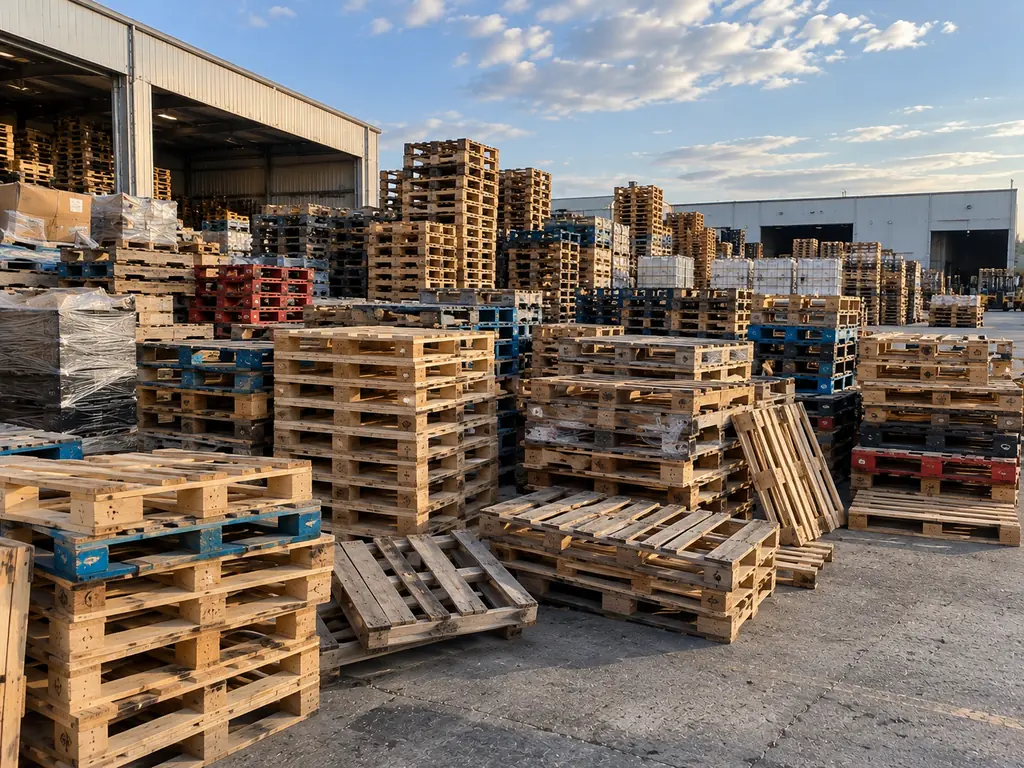
Four variables, in descending order of importance. Everything else is noise.
- Footprint. A 48x40 GMA has a liquid market and predictable demand. A 45x45 does not. This single factor can swing the price by 300%.
- Condition. Sound, repairable and beyond-repair are three different products. Be honest about the mix; buyers who are surprised on arrival price defensively next time.
- Quantity. Volume pays for the trailer. Below about 400 units the freight starts eating the price; above 1,000 it stops mattering.
- Distance and access. A dock forty minutes from the yard with a forklift and a clear approach is worth real money against a site an hour out with no equipment.
Who to sell to
| Buyer type | Pays | Collects | Best for |
|---|---|---|---|
| Recycling yard (like us) | Per unit, ACH | Yes, with own trailers | Volume, mixed condition, standing supply |
| Broker | Per unit, often slower | Subcontracted | Occasional loads, unusual sizes |
| Local reseller / classified ads | Cash | No, you deliver | Small counts, under 50 units |
| Waste contractor | Nothing; charges you | Yes | Genuinely contaminated wood only |
The classified-ad route is legitimate for small counts and often pays surprisingly well per unit — but it comes with no-shows, cash handling and someone reversing a pickup truck into your dock. Above about 100 units it stops being worth the friction.
Preparing the load
None of this is compulsory. All of it pays. The full version is on the buyback checklist, which is designed to be printed and left on a dock wall.
- Sort by footprint. Worth roughly a dollar a unit on a mixed load.
- Pull pooled pallets out. Blue CHEP, red LPR, brown PECO. Nobody legitimate will buy them and offering them damages your credibility.
- Stack square, 20 – 25 high. Matches standard banding and loads fast.
- Keep them dry. A tarp for a week before collection is the highest-return work available.
- Separate the obvious write-offs. Not to discard — they still sell — but so the count and grade are honest.
- Clear the approach. A forklift needs a straight run.
Getting the deal right
Four things to settle in writing before a trailer arrives. Every dispute we have ever heard of traces back to one of them being left vague.
The rate, per grade
Not an average. If sound, repairable and scrap units are all in the load, agree three numbers.
Who pays for collection
And what the threshold is. "Free above 400 units" is a clear term; "usually free" is not.
How the count is verified
Deck count at the yard with photographs, or counted at loading and signed. Either is fine; agreeing afterwards is not.
Payment terms
Method and timing. Ours is ACH within five business days of the confirmed count.
And one more, easy to forget: ask for the batch reference. It lets you report the diversion properly, and it is the difference between "we recycled our pallets" and a number your auditor will accept.
Reading your own stack before anyone quotes it
Fifteen minutes with a stack tells you roughly what an offer should look like, which is the best possible preparation for receiving one.
- 1
Count the stacks, not the pallets
Stacks × height is fine. Nobody expects a unit count and nobody will hold you to one.
- 2
Measure one pallet
Length along the stringers first. 48" x 40" covers most of North America.
- 3
Pull ten at random and grade them
Sound both decks? Broken board? Cracked stringer? Three piles is enough.
- 4
Work out the mix
If seven of ten are sound, expect roughly 70% at the top rate.
- 5
Pull the pooled pallets
Painted blocks or stringer ends. They are not yours to sell.
- 6
Note anything unusual
Mould, staining, fire damage, unusual stencils, wet base rows.
| Category | Share | Units | Rate | Value |
|---|---|---|---|---|
| Sound 48x40 | 62% | 310 | $6.50 | $2,015 |
| Repairable | 24% | 120 | $3.40 | $408 |
| Beyond repair | 10% | 50 | $1.25 | $63 |
| Odd sizes | 3% | 15 | $3.00 | $45 |
| Pooled (returned free) | 1% | 5 | — | — |
| Expected total | 500 | ≈ $2,531 |
Contract terms worth having in writing
Pallet buyback is a simple transaction that goes wrong in a small number of predictable ways, all of which a paragraph of email prevents.
- Rate per grade, not a blended average. If sound, repairable and scrap are all in the load, agree three numbers.
- Who pays for collection, and the volume threshold above which it is free.
- How the count is verified — deck count at the yard with photographs, or counted at loading and signed.
- What happens to rejects — returned, deducted, or taken at scrap rate.
- Payment method and timing. Ours is ACH within five business days of a confirmed count.
- What happens if the load differs materially from the description — contact before processing, not after.
- The batch reference, so you can report the diversion properly.
Who owns the pallets?
Pallets that arrived with inbound freight and were not charged to you are generally yours to dispose of. The exceptions matter: pooled pallets remain the property of the pool operator regardless of how they reached you, and pallets supplied under a returnable-packaging agreement with a supplier belong to that supplier. If either applies and you are unsure, ask before you sell.
Selling regularly rather than occasionally
The gap between an occasional seller and a programme seller is about 18% on the per-unit rate, and almost all of it comes from things that have nothing to do with negotiation.
| Factor | Occasional sale | Standing programme |
|---|---|---|
| Collection | Dedicated trip | Paired with a delivery |
| Scheduling | Whatever slot is free | Fixed slot, planned route |
| Grading | Unknown mix each time | Known mix; priced accurately |
| Accumulation | Weathered by the time it goes | Collected before it degrades |
| Sorting | Often none | Dock team knows the routine |
| Administration | Quote each time | One rate card, monthly statement |
| Typical realised rate | $5.40 | $6.40 |
The largest single component in that gap is weathering. Pallets collected within three weeks of being generated grade substantially better than pallets that have sat outside for a season, and no amount of negotiation recovers what the weather took.
Questions people actually ask
How much are used pallets worth?
Can I sell pallets I did not pay for?
Do I need a minimum quantity?
How do I identify a pooled pallet?
Is it better to sell or to recycle?
Should I sell to whoever offers the most?
Can I sell pallets on classified ads instead?
What if my pallets have a customer's branding on them?
Do you buy pallets from residential sellers?
Is there a best time of year to sell?
Let's keep your pallets in the loop
Whether you have 40 broken cores behind the dock or need 4,000 Grade A pallets a month, the conversation starts the same way.