Product · Used wood
Used wooden pallets, graded by hand
The backbone of the yard. Fifteen footprints, three grades, and a written standard that means the same thing in January as it does in July.
Request pricing
Everything marked with a star is required. The rest helps us quote faster.
Used wooden pallets are our largest product line: hand-graded 48" x 40" GMA stringer pallets plus Euro, block, square and odd footprints in Grade A (#1), Grade B (#2) and core condition.
Grade A 48x40 typically runs $8.50–$13.50 and Grade B $5.50–$9.00 ex-yard in Denver. Stock turns weekly, so availability is confirmed per order rather than published as a live count.
Species, and why it matters more than people think
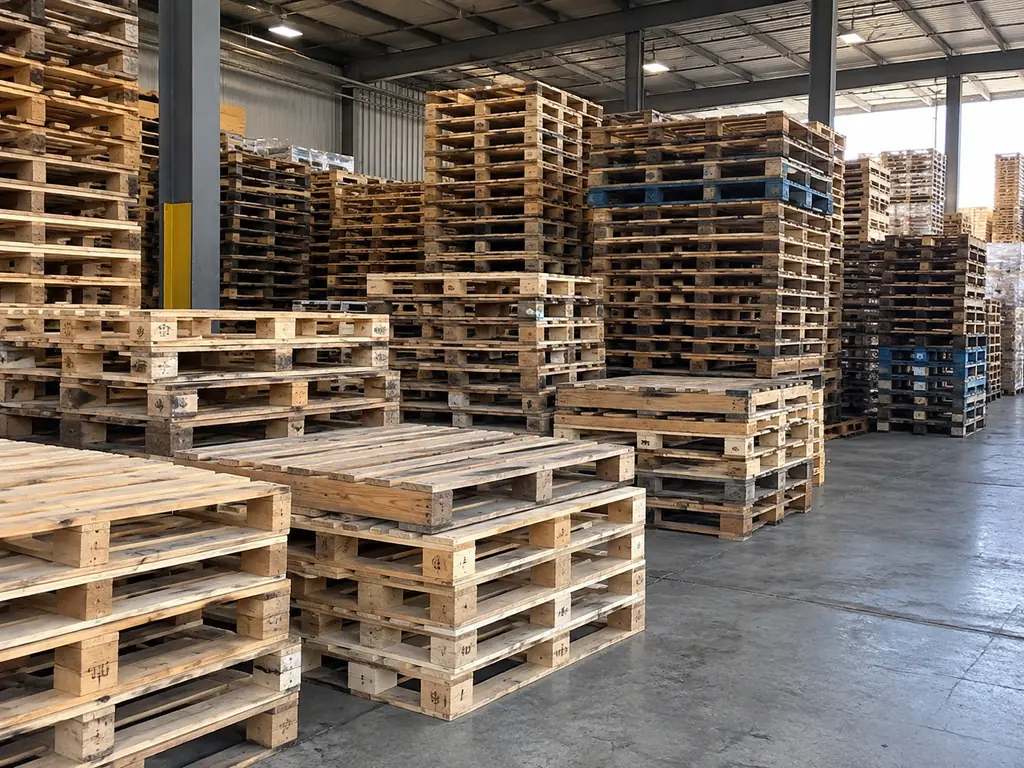
Most North American recycled pallets are mixed hardwood — oak, poplar, maple, gum — because that is what the new-pallet industry builds with in the east and midwest. Softwood pallets, mostly pine and fir, are more common in the west and on imported freight. The difference is not cosmetic.
| Mixed hardwood | Softwood (pine / fir) | |
|---|---|---|
| Typical weight, 48x40 | 33 – 40 lb | 26 – 33 lb |
| Load capacity | Higher for the same section | Lower; needs thicker members |
| Nail holding | Excellent | Moderate; more shiners over time |
| Repairability | Very good | Good, but splits more on the nail line |
| Typical lives | 6 – 8 | 3 – 5 |
| Cost | Higher | Lower |
| Best for | Racked storage, automation, repeat loops | One-way shipments, light loads, air freight |
What we stock, week to week
48" x 40" GMA · Grade A
The default. Original stringers, complete decks, no more than two replaced boards. Suitable for racking and most automation.
Open48" x 40" GMA · Grade B
Repaired and sound: companion stringers and plugs permitted. The workhorse for floor stacking and general shipping.
Euro / EPAL
Genuine stamped 1200 x 800 block pallets. Limited and worth reserving in advance.
OpenSquares: 36", 42", 44", 48"
Keg, drum and reel footprints. Seasonal on the 36" square, steady on the rest.
Block pallets (non-pooled)
Nine-block, full four-way entry. Never pool property — we do not trade in it.
Cores and dunnage
Serviceable lumber rather than serviceable pallets. Cheap, honest, and clearly labelled as such.
Odd footprints come and go with whatever the yard takes in. If you need something unusual, tell us and we will watch for it — we hold a want-list and it works more often than you would expect.
Before you buy: five checks
- Confirm the orientation. A 48x40 with stringers on the 48" side behaves differently on a conveyor than the same pallet rotated. Ask which you are getting.
- Ask about fasteners. Ring-shank and screw-shank nails hold; smooth-shank nails back out and become shiners.
- Check the deck-board count. Seven-board tops are standard; five-board tops flex more under drum and roll loads.
- Specify moisture. If the pallets go into a cold store or a dry room, say so — wet wood will make itself known.
- Decide about banding. Banded lots of 20 or 25 unload faster but cost a little more. For high-volume receiving it pays for itself.
For the full inspection standard, including what should make you reject a pallet on arrival, see safety and inspection.
Anatomy of a 48" x 40" stringer pallet
Almost every conversation about used pallets uses these words. Knowing which part is which turns a vague complaint into a specific, fixable one.
| Component | Typical size | Job | How it fails |
|---|---|---|---|
| Top deck board (centre) | 40" x 5.5" x 0.6" | Carries and spreads the load | Splits along the grain under point loads |
| Lead board | 40" x 5.5" x 0.6" | Takes fork impact at each end | Crushed or torn off by mis-set forks |
| Stringer | 48" x 3.5" x 1.5" | Primary structural member | Cracks at the notch or along the nail line |
| Notch | 9" x 1.5" | Allows partial four-way fork entry | Blow-out above or below the cut |
| Bottom deck board | 40" x 5.5" x 0.6" | Spreads load into the floor or rack | Dragged off on concrete |
| Fastener | Ring-shank, 2.25" | Holds everything together | Backs out as a shiner if smooth-shank |
| Chamfer | Edge bevel | Eases fork and jack entry | Wears away; not structural |
Board counts and what they mean
A seven-board top deck is the GMA standard. Five-board decks exist and are cheaper; they flex more under drums, rolls and any concentrated load, and they let small cartons drop through the gaps. Nine-board and butted decks show up on specialist pallets where deck coverage matters more than weight.
Deck coverage on a standard 48x40 is about 87%. If you are shipping anything small enough to fall through a 1.5" gap, you want a butted deck, a slip sheet or a plywood cap rather than a different grade.
Storage, handling and getting a second life out of them
A used pallet's remaining life is decided far more by how you store and handle it than by what grade it arrived as. Three or four cycles is typical in a careless operation; six to eight is normal in a careful one, on identical stock.
- Keep them off the ground. Four inches of air under the bottom pallet prevents the mould that destroys the bottom rows of an outdoor stack.
- Keep the sides of a tarp open. A wrapped tarp traps meltwater against the deck and is worse than no tarp at all.
- Stack square, same orientation. Leaning stacks collect snow in the gaps and freeze into one object.
- Train fork entry. On a stringer pallet, enter through the open faces where you can. Notch entry causes 14% of the damage we repair.
- Spread concentrated loads. Anything under about 12" square and over 400 lb wants a spreader.
- Do not rack Grade B. A companion stringer changes the load path and an unsupported span is unforgiving.
- Mark your grades. A painted stringer end costs nothing and stops a Grade B pallet reaching a rack beam by accident.
What a used pallet costs over its life
Unit price is the wrong comparison for any pallet that comes back to you. Cost per trip is the right one, and it frequently reverses the answer.
| Pallet | Purchase | Repairs | Trips | Cost per trip |
|---|---|---|---|---|
| Recycled Grade A hardwood | $10.75 | $3.00 | 5 | $2.75 |
| Recycled Grade B hardwood | $7.25 | $0 | 2 | $3.63 |
| Recycled softwood | $8.40 | $2.40 | 3 | $3.60 |
| New hardwood | $21.00 | $3.00 | 9 | $2.67 |
| Block pallet (non-pooled) | $18.00 | $6.00 | 12 | $2.00 |
| Plastic, rackable | $52.00 | $0 | 40 | $1.30 |
Read the bottom two rows carefully before acting on them. They only hold if the pallet comes back. In an open loop where the pallet leaves your control and does not return, every one of those figures collapses to the purchase price, and the cheapest pallet wins decisively.
The test is simple: what fraction of pallets you send out do you see again? If it is near zero, buy Grade B and stop thinking about it. If it is near one, the arithmetic above is worth a proper look.
Questions people actually ask
Are used pallets strong enough for racking?
Can I mix footprints in one order?
How clean are they?
Do used pallets come with a warranty?
How do I tell hardwood from softwood?
Do you sell pallets by weight or by unit?
Can I get pallets washed?
What is deck coverage and should I care?
Are used pallets safe to burn?
Let's keep your pallets in the loop
Whether you have 40 broken cores behind the dock or need 4,000 Grade A pallets a month, the conversation starts the same way.