Service · Removal
Pallet removal before it becomes a fire-code problem
Scheduled routes, on-call clear-outs and drop trailers you fill at your own pace. Most removals cost nothing; many pay you.
Request pricing
Everything marked with a star is required. The rest helps us quote faster.
RePallet Co. removes accumulated pallets from docks, yards and warehouses across the Denver metro and the Front Range. Collections are typically free above roughly 400 units inside the metro, and sound cores are purchased rather than merely taken away.
Options run from a one-off clear-out to a standing weekly route or a drop trailer left permanently on site. Metro scheduling is usually two to four business days; the wider Front Range runs on consolidated routes.
Four ways to get them gone
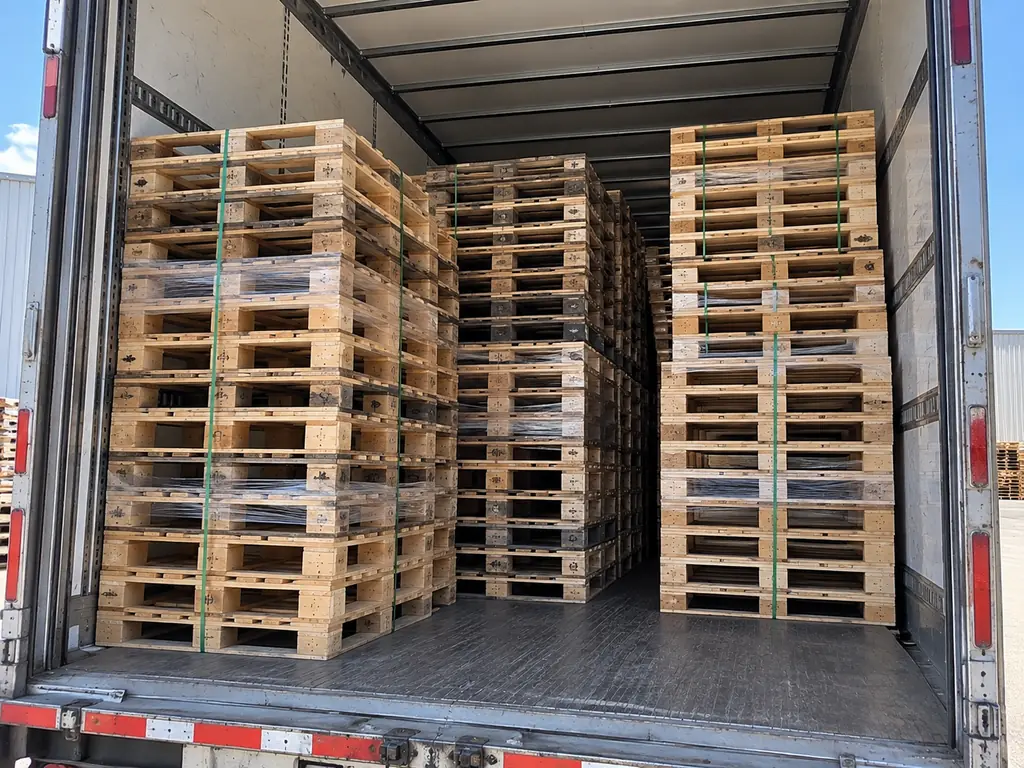
One-off clear-out
A single trailer for a stack that got away from you. Best for seasonal build-ups, post-project clean-downs or a landlord inspection next Tuesday.
Scheduled route
Weekly, fortnightly or monthly at a fixed slot. Your dock team stops thinking about it; our dispatcher owns it.
Drop trailer
We leave a trailer in your yard, you load it as pallets appear, we swap it when it is full. The lowest-friction option for continuous generators.
Full decommission
Warehouse closures and relocations, including mixed debris, racking dunnage and banding. Priced as a project with your facilities team.
The right answer is almost always determined by how predictable your volume is, not by how big it is. A brewery that generates 60 keg squares every Thursday is easier to serve than a distributor that generates 900 pallets four times a year — and the pricing reflects that.
Access, and the things that go wrong
Most failed collections fail for boring reasons. We would rather ask six awkward questions by email than send a 53' trailer to a site it cannot turn in.
- Can a 53' trailer enter, turn and exit without reversing onto a public road?
- Is there a dock leveller, a ramp, or are we loading from ground level?
- Do you have a forklift and an operator, or do we need to bring a moffett?
- What are the real dock hours, including the lunch hour nobody mentions?
- Is there a site induction, a PPE requirement or a gate pass we need in advance?
- Are the pallets under cover, or has it snowed on them for three weeks?
Removal versus a skip
A roll-off container is the default answer in most facilities, and it is almost always the wrong one for pallets. Wood is bulky, light and valuable — precisely the combination that skips handle worst.
| 30-yard roll-off | RePallet removal | |
|---|---|---|
| Capacity | ≈150 pallets, loosely thrown | Unlimited, stacked and banded |
| Cost to you | $450 – $700 per haul | $0 above ~400 units |
| Revenue to you | None | $225 – $1,275 depending on grade |
| Landfill diverted | 0 – 100% (unverified) | 100%, documented |
| Labour | Your team throws them in | Our driver loads |
| Reporting | Weight ticket | Full Pallet Passport batch record |
The one case where a skip genuinely wins is heavily contaminated wood that we are not permitted to handle. We will tell you when that is true and point you at a licensed route.
Fire code, pest control and the reasons to act early
Accumulated pallets stop being an operations annoyance and start being a compliance question faster than most facilities teams expect. None of this is scare-mongering — it is simply the part of the conversation that usually arrives via a fire marshal rather than via a supplier.
- Fuel load. Idle wooden pallets are among the highest fuel-load materials commonly stored in a warehouse. Fire codes treat stacked idle pallets more strictly than almost any other ordinary commodity, and indoor idle storage limits are low.
- Stack height. Outdoor idle pallet storage is generally governed by height and separation distance from buildings and property lines.
- Pest harbourage. A stack standing six weeks is rodent habitat. In a food facility that is an audit finding before it is a pest problem.
- Egress and access. Pallets accumulate where there is room, which is frequently a fire lane or a turning circle.
- Sprinkler design. Idle pallet storage can exceed what an existing sprinkler system was designed for.
Warehouse decommissions and site clearances
Relocations and closures are a different kind of job: high volume, mixed material, a hard date and usually somebody's deposit on the line. We run several a year and they are priced as projects rather than as collections.
- 1
Site walk
Free, and worth the twenty minutes. We photograph everything and count the stacks.
- 2
Scope and split
What we take, what needs a licensed waste route, and what is worth money.
- 3
Fixed price
A project figure rather than a per-load rate, with the buyback netted against it.
- 4
Phased or single sweep
Phased suits a live relocation; a single sweep suits a hard handback date.
- 5
Handback documentation
Photographs, weights, batch references and a clearance statement for the landlord.
| Site | Units | Mixed debris | Duration | Net to customer |
|---|---|---|---|---|
| Distribution centre, Aurora | 9,100 | Banding, dunnage, racking timber | 6 days | +$21,400 |
| Food packer, Commerce City | 3,400 | Some contaminated units | 3 days | +$6,900 |
| Machine shop, Longmont | 620 | Custom crates, heavy skids | 1 day | −$340 |
The third one is included deliberately: a small clearance of custom crates and heavy skids has little resale value, and the honest answer was that it would cost the customer money. It still cost less than a skip.
Scheduling in practice
| Factor | Effect |
|---|---|
| Distance from 4890 Geneva St | Metro 2 – 4 days; Front Range within a week |
| Whether you are on a standing route | Same week, often next day |
| Whether the run can be paired | Pairs get priority because they are cheaper to run |
| Volume | Above ~400 units the trailer is worth sending on its own |
| Access and equipment | Moffett and box-truck jobs slot into fewer routes |
| Season | November – March carries a weather buffer |
| Notice given | A week of flexibility is worth a better slot and a better rate |
The single best thing you can do for your own scheduling is to tell us the cadence rather than the crisis. A site that says “about 300 units every three weeks” gets slotted into a route permanently. A site that calls when the stack reaches the fire lane gets whatever is available.
Questions people actually ask
How quickly can you collect?
Is removal really free?
Can you leave a trailer on our site?
Do you remove other warehouse waste?
Do you work outside normal hours?
Can you collect outside working hours?
Do you need someone on site?
What if the stack is bigger than I estimated?
Do you remove racking, banding and general debris?
Is there a call-out charge?
Let's keep your pallets in the loop
Whether you have 40 broken cores behind the dock or need 4,000 Grade A pallets a month, the conversation starts the same way.